I Pay $500 a Month for AI and Still Hit the Limits
I spend about $500 a month on AI subscriptions. That buys me access to Grok, Codex and Claude Code, plus a recurring side job: watching meters and deciding which model deserves the next piece of work.
Here is the strange part. I am not paying for novelty. These tools sit inside real work. They research, write code, inspect systems and finish tasks that used to eat whole afternoons. The bill can make sense while the experience still feels unfinished.
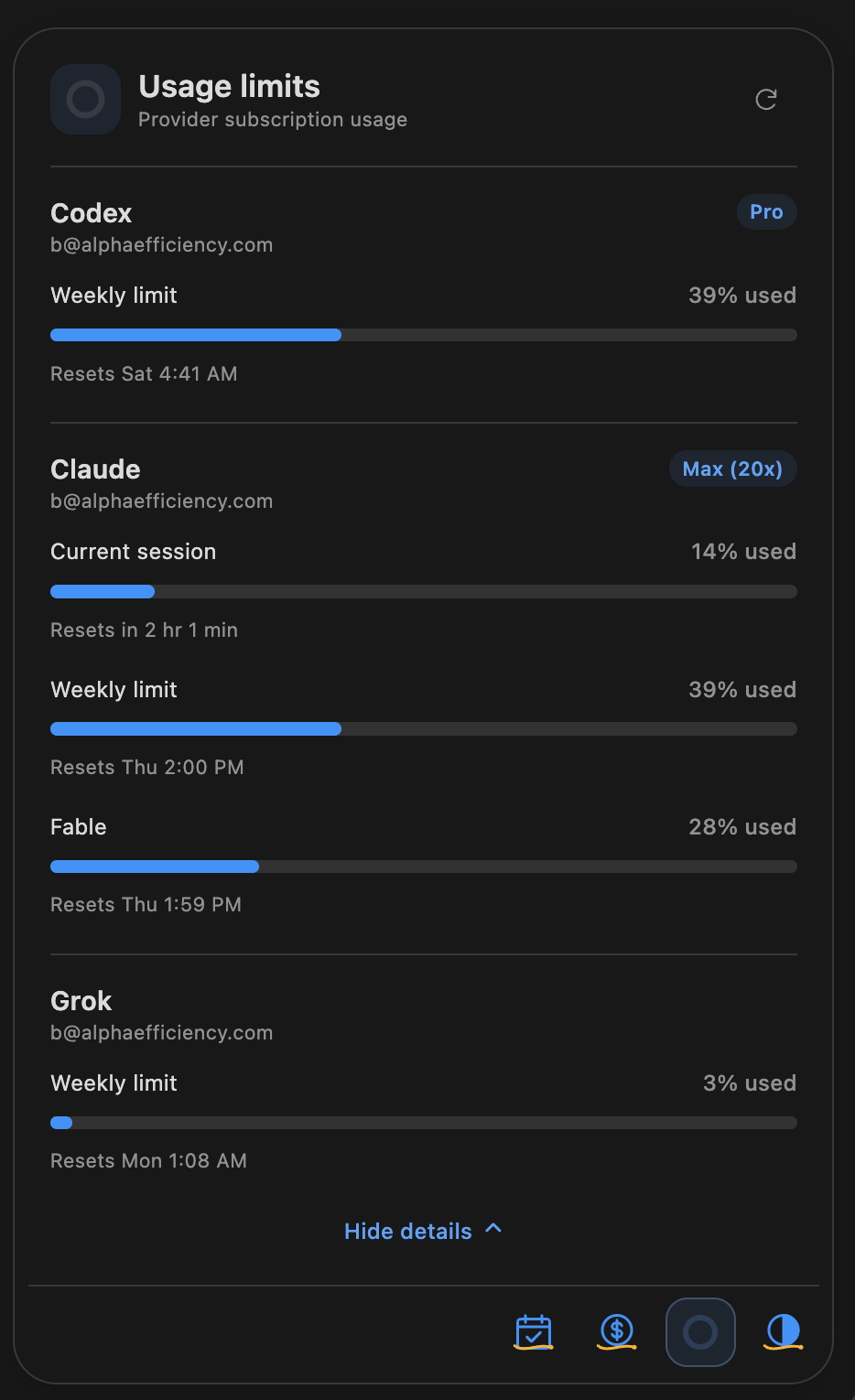
A subscription should remove friction. Instead, each provider gives me a different limit, a different reset clock and a different definition of “fast.” I can have plenty of room in Grok, 39% of my weekly Codex allowance used, and a Claude session meter moving on its own schedule.
The percentage is almost useless without the work
Thirty-nine percent sounds precise. It does not tell me how many customer outcomes I shipped, how much reasoning the model burned before answering, or whether the remaining allowance can finish a large codebase task.
That is the real subscription problem. The meter counts consumption while I care about completed work.
Two models can show the same weekly usage and create wildly different days. One starts talking in under a second but takes a long time to finish. Another thinks in silence, then streams a tighter answer. A third moves quickly and spends more tokens along the way. The progress bars flatten those differences into a cheerful blue line.
Grok vs Codex vs Claude Code
The cleanest public comparison uses the model engines behind these coding products: Grok 4.7 for Grok Build, GPT-5.6 Sol for Codex, and Claude Opus 5 for Claude Code. Product speed also depends on tool calls, repository size, network latency and the agent loop, so this is an engine comparison rather than a stopwatch for the apps.
| Model | Intelligence | Output speed | Cost per 1M tokens input / output |
|---|---|---|---|
| Grok 4.7 (xhigh) | 46 | 39 t/s | $2 / $6 |
| Grok 4.7 (high) | 46 | 53 t/s | $2 / $6 |
| Claude Opus 5 (xhigh) | 50 | 54 t/s | $5 / $25 |
| Claude Opus 5 (max) | 51 | 56–61 t/s | $5 / $25 |
| GPT-5.6 Sol (xhigh) | 44 | 70 t/s | $4 / $20 |
| Grok 4.7 Fast (xhigh), Grok Build | 46 | ~78 t/s, 2× claim | $4 / $12 |
| GPT-5.6 Sol (max) | 47 | 79 t/s | $4 / $20 |
| Grok 4.7 Fast (high), Grok Build | 46 | ~106 t/s, 2× claim | $4 / $12 |
| GPT-5.6 Sol Fast (xhigh) | 44 | up to ~175 t/s, 2.5× claim | $8 / $40 |
| GPT-5.6 Sol Fast (max) | 47 | up to ~198 t/s, 2.5× claim | $8 / $40 |
Intelligence is the Artificial Analysis Intelligence Index. Standard speeds are measured output rates. Grok Fast estimates apply xAI's 2× claim to measured Grok rates. Sol Fast figures apply OpenAI's “up to 2.5×” claim to measured Sol rates. Those Fast rows are ceilings, not independent measurements. Prices are short-context list rates as of September 21, 2026.
The table makes the trade obvious. Claude Opus 5 wins this group on the intelligence index, but it costs more per output token and streams slower than Sol. Standard Grok is inexpensive and starts quickly, yet its long output stream can feel slow. Sol gives Codex the best measured standard throughput here. Fast modes buy time by charging more for the same underlying intelligence.
The source numbers matter. Artificial Analysis reports Opus 5 max at an intelligence score of 51 and about 56 tokens per second. OpenAI says Sol Fast can run up to 2.5 times faster, with a service target above 80 tokens per second for 99% of requests. xAI says Grok 4.7 Fast is the same model on faster infrastructure at twice the standard token rates.
Speed is more than tokens per second
Grok can feel fast because the first answer token arrives quickly. Opus may sit quietly before it responds. Sol can take even longer to show the first answer, then move through the output faster once it starts.
That gives us three clocks:
- How long the model thinks before the first useful token appears.
- How fast the answer streams after it begins.
- How long the whole task takes, including tools, retries and review.
Tokens per second measures only the middle clock. For a short answer, the first clock dominates. For a long coding task, the third one decides whether the model saved the afternoon.
Subscriptions turn model choice into operations
One plan would be simpler. It would also force every job through the same strengths and weaknesses.
Opus earns its keep when judgment matters more than speed. Sol is easier to justify for long coding loops where steady throughput changes the feel of the work. Grok is useful when a quick start and lower token price matter, with the Fast tier available when the wait becomes the bottleneck.
The annoying part is that I have to make that routing decision before the task begins. I am estimating difficulty, likely output length, context size and remaining allowance while trying to do the actual work. The AI freed me from repetitive execution and handed me capacity planning.
I can laugh at that because the tools still create more freedom than friction. But this is where the industry has work left to do. A serious AI workspace should show expected task capacity, reset risk and cost before I press send. “39% used” is accounting. I need a forecast.
What I would measure instead
If your work depends on several AI tools, track one week in plain language:
- Tasks finished without a restart.
- Minutes from prompt to usable result.
- Human review time after the model stops.
- Limit events that forced a tool switch.
- Cost per completed task, including the subscription.
That sheet will tell you more than the provider dashboards. It may also show that the smartest model is not the best default, or that the cheap model becomes expensive when it talks for 81,000 tokens.
I am keeping the $500 stack because the work it finishes is worth more than the bill. I just refuse to confuse paying for access with buying certainty.
Audit your own week. Route the hard judgment, the long build and the quick search on purpose. Make the meters compete on finished work.
Build your AI agent team in 8 weeks
If you want these models completing real work inside your business, join me in the Agentic Business Sprint.
Eight weeks to build the agents. Twelve weeks of direct access to me while they run. Your repetitive work moves to the system, and you keep the judgment.